No Author Selected

TECHNICAL INFORMATION UPDATE - KATANA ZIRCONIA Block

NOW 18 Minutes Sintering using the CEREC SpeedFire


KATANA™ Zirconia Block, the innovative multi-layered zirconia block*1, can be used with Dentsply Sirona's CEREC system*2. Now the 18 minutes sintering program*3 is developed and installed into CEREC SpeedFire. New sintering technology makes it possible to fabricate full zirconia restoration in approx. 35 minutes.

*1 CL shade is not a multi layered block.
*2 For using this product, CEREC software 4.5.2 or later is required, and for 18 minutes sintering, software 4.6 or later is required.
*3 In case that wall thickness is less than 3mm using dry milling.
*4 Dry milling is recommended.

If wet milling/grinding is performed by using cooling water contaminated by silica-based glass ceramics (lithium disilicate glass, etc.), the translucency of the zirconia may be reduced after baking. Before wet milling/grinding, clean the milling/grinding chamber, cooling water tank and filter insert. The cooling water must be changed in order to assure optimum results.

The official announcement can be found here

Create natural gloss instantly with CLEARFIL MAJESTY™ ES Flow

An ideal composite material should satisfy three basic requirements: function, aesthetics and biocompatibility. A member of the CLEARFIL MAJESTY family, Kuraray Noritake Dental’s CLEARFIL MAJESTY™ ES Flow combines excellent handling, polishability and mechanical strength to provide a solution for all cavity classes. This universal flowable composite employs silane and filler technologies to maximise both its procedural and aesthetic outcomes, allowing dentists to create long-lasting restorations with reduced chairside time.


A new standard for flowable composites

Traditionally, a composite’s flowability has been inversely related to its filler content. When flowable composites were first introduced in the mid-1990s, their lower viscosity was enabled by a filler level much lower than that of conventional composites. This, however, meant that these flowables fared poorly in a clinical setting, demonstrating inferior mechanical properties when compared to traditional hybrid composites.


With CLEARFIL MAJESTY™ ES Flow, dentists can now use a flowable composite with mechanical properties comparable to those of conventional alternatives. Thanks to Kuraray Noritake Dental’s silane technology, millions of submicron filler particles fit into the composite, reliably adhering to the resin and maintaining long-term stability. CLEARFIL MAJESTY™ ES Flow possesses a scientifically tested flexural strength of over 150 MPa, similar to that of a universal nano hybrid composite, making it suitable for use in Class I and II restorations.


Aesthetic restorations

However, the small, durable particles of CLEARFIL MAJESTY™ ES Flow provide more than just mechanical reliability. Special cluster fillers provide a light diffusion effect that is similar to that of natural teeth, meaning that the material blends effortlessly with the existing tooth structure. Unlike other flowables, CLEARFIL MAJESTY™ ES Flow is glossy immediately after curing. This gloss can be improved with remarkable simplicity—simply wipe the cured resin with an ethanol-moistened gauze or cotton roll to produce a smooth surface that is proven to maintain its gloss over time.


Ideal handling

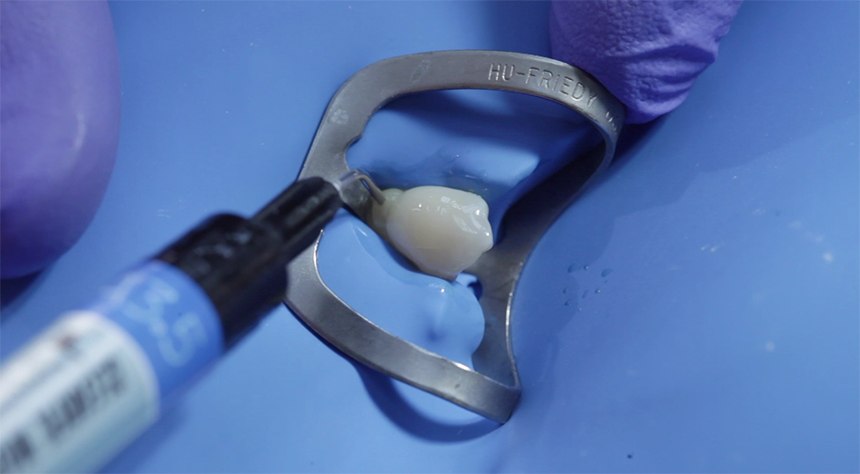
CLEARFIL MAJESTY™ ES Flow’s low viscosity monomers ensure that it has excellent handling characteristics, promising better sculpting for the dentist. The flowable composite does not stick to the needle tip or to any instruments, only adhering to the area to which it is applied, while the proprietary design of the syringe itself minimises air bubbles when dispensing. Once dispensed, the paste possesses great consistency with its non-slumping formula, ensuring that it can maintain its shape. A truly universal composite, CLEARFIL MAJESTY™ ES Flow allows dentists to create highly aesthetic restorations with ease.


Obtain results in four simple steps

Creating aesthetic and durable restorations has never been more achievable. Simply prepare the cavity and apply bonding, dispense and sculpt the CLEARFIL MAJESTY™ ES Flow, light-cure and, finally, polish. It’s as easy as that.

Create natural gloss instantly with CLEARFIL MAJESTY™ ES Flow

An ideal composite material should satisfy three basic requirements: function, aesthetics and biocompatibility. A member of the CLEARFIL MAJESTY family, Kuraray Noritake Dental’s CLEARFIL MAJESTY™ ES Flow combines excellent handling, polishability and mechanical strength to provide a solution for all cavity classes. This universal flowable composite employs silane and filler technologies to maximise both its procedural and aesthetic outcomes, allowing dentists to create long-lasting restorations with reduced chairside time.


A new standard for flowable composites

Traditionally, a composite’s flowability has been inversely related to its filler content. When flowable composites were first introduced in the mid-1990s, their lower viscosity was enabled by a filler level much lower than that of conventional composites. This, however, meant that these flowables fared poorly in a clinical setting, demonstrating inferior mechanical properties when compared to traditional hybrid composites.


With CLEARFIL MAJESTY™ ES Flow, dentists can now use a flowable composite with mechanical properties comparable to those of conventional alternatives. Thanks to Kuraray Noritake Dental’s silane technology, millions of submicron filler particles fit into the composite, reliably adhering to the resin and maintaining long-term stability. CLEARFIL MAJESTY™ ES Flow possesses a scientifically tested flexural strength of over 150 MPa, similar to that of a universal nano hybrid composite, making it suitable for use in Class I and II restorations.


Aesthetic restorations

However, the small, durable particles of CLEARFIL MAJESTY™ ES Flow provide more than just mechanical reliability. Special cluster fillers provide a light diffusion effect that is similar to that of natural teeth, meaning that the material blends effortlessly with the existing tooth structure. Unlike other flowables, CLEARFIL MAJESTY™ ES Flow is glossy immediately after curing. This gloss can be improved with remarkable simplicity—simply wipe the cured resin with an ethanol-moistened gauze or cotton roll to produce a smooth surface that is proven to maintain its gloss over time.


Ideal handling

CLEARFIL MAJESTY™ ES Flow’s low viscosity monomers ensure that it has excellent handling characteristics, promising better sculpting for the dentist. The flowable composite does not stick to the needle tip or to any instruments, only adhering to the area to which it is applied, while the proprietary design of the syringe itself minimises air bubbles when dispensing. Once dispensed, the paste possesses great consistency with its non-slumping formula, ensuring that it can maintain its shape. A truly universal composite, CLEARFIL MAJESTY™ ES Flow allows dentists to create highly aesthetic restorations with ease.


Obtain results in four simple steps

Creating aesthetic and durable restorations has never been more achievable. Simply prepare the cavity and apply bonding, dispense and sculpt the CLEARFIL MAJESTY™ ES Flow, light-cure and, finally, polish. It’s as easy as that.

The choice for professionals

How To: Cementing Veneers using PANAVIA™ V5

Paul de Kok, Authorized Restoritive Dentist(KvPA), teaches Indirect restoritive dentistry(ACTA) , Researcher at Materials Science department (ACTA), demonstrates in this instructional video how excellent lasting aesthetic results are achieved by using PANAVIA™ V5.

The choice for professionals

How To: Cementing Veneers using PANAVIA™ V5

Paul de Kok, Authorized Restoritive Dentist(KvPA), teaches Indirect restoritive dentistry(ACTA) , Researcher at Materials Science department (ACTA), demonstrates in this instructional video how excellent lasting aesthetic results are achieved by using PANAVIA™ V5.

CLEARFIL Universal Bond Quick with CLEARFIL MAJESTY ES Flow rated excellent

DENTAL ADVISOR SIX-MONTH PROGRESS REPORT


Summary
Over a six-month period, 96 restorations were placed. The clinical performance at the time of placement was excellent for esthetics, handling, ease of adjustment, and ease of finish/polish. There were no reports of post-operative sensitivity or debonding. Based on the placement period, CLEARFIL Universal Bond Quick with CLEARFIL MAJESTY ES Flow received a clinical performance rating of 100%.


Description:

CLEARFIL MAJESTY ES Flow is a light-cured, universal flowable composite.

It contains submicron fillers that are treated with a proprietary silane

coupling agent to provide for low shrinkage and high mechanical

properties. The submicron fillers and high filler load provide for esthetics.

CLEARFIL Universal Bond Quick is a single-bottle, universal bonding agent

that contains a novel rapid bond technology and releases fluoride. It is

compatible with total-, self- and selective-etch techniques and with light-,

self- and dual-cured materials (with CLEARFIL DC Activator).


Clinical Evaluation Protocol (Six Months):

A total of 96 CLEARFIL Universal Bond Quick with CLEARFIL MAJESTY ES

Flow restorations were placed in 44 molars, 26 premolars and 26 anterior

teeth (Figure 1). The classification of restorations was recorded as 44 Class

I, 7 Class II, 1 Class III, 30 Class V, and 14 Class VI restorations (Figure 2).

Kuraray Noritake Dental Inc.


Results at Six Months:

There were no reports of post-operative sensitivity for CLEARFIL Universal

Bond Quick with CLEARFIL MAJESTY ES Flow. All 96 restorations received

excellent ratings of five for esthetics, handling, ease of adjustment, and

ease of finish/polish (Figure 3). No debonding was observed.


All restorations were evaluated at placement in the following areas: lack
of post-operative sensitivity, esthetics, handling, ease of adjustment, and
ease of finish/polish. Restorations were evaluated on a 1-5 rating scale:
1 = poor, 2 = fair, 3 = good, 4 = very good, 5 = excellent.


Consultants’ Comments
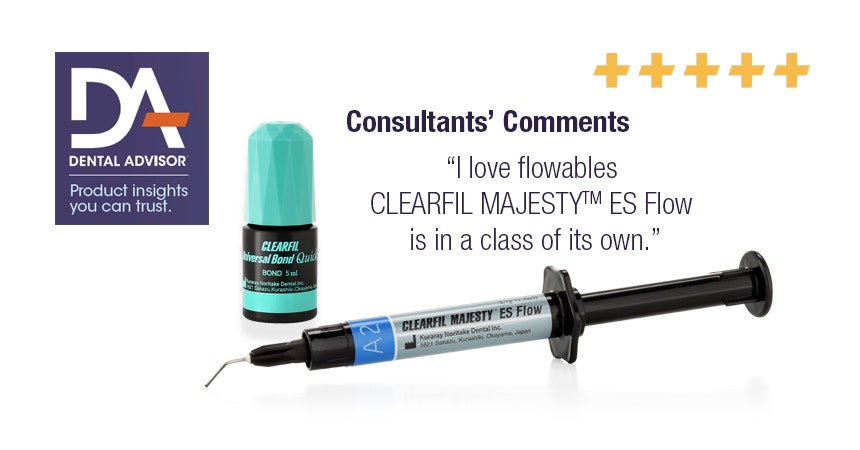
• “I love flowables - CLEARFIL MAJESTY ES Flow is in a class of its own.”
• “I use CLEARFIL MAJESTY ES Flow regularly in areas of incipient decay
- flows well, very esthetic and polishes easily.”
• “CLEARFIL MAJESTY ES Flow is my go-to flowable to repair small chips
in anterior teeth. It blends seamlessly with the tooth.”
• “Great to use in abfraction areas in conjunction with CLEARFIL
Universal Bond Quick. CLEARFIL MAJESTY ES Flow bonds well and is
very easy to finish and polish. Patients love the outcome.”


CLEARFIL Universal Bond Quick with CLEARFIL MAJESTY ES Flow rated excellent

DENTAL ADVISOR SIX-MONTH PROGRESS REPORT


Summary
Over a six-month period, 96 restorations were placed. The clinical performance at the time of placement was excellent for esthetics, handling, ease of adjustment, and ease of finish/polish. There were no reports of post-operative sensitivity or debonding. Based on the placement period, CLEARFIL Universal Bond Quick with CLEARFIL MAJESTY ES Flow received a clinical performance rating of 100%.


Description:

CLEARFIL MAJESTY ES Flow is a light-cured, universal flowable composite.

It contains submicron fillers that are treated with a proprietary silane

coupling agent to provide for low shrinkage and high mechanical

properties. The submicron fillers and high filler load provide for esthetics.

CLEARFIL Universal Bond Quick is a single-bottle, universal bonding agent

that contains a novel rapid bond technology and releases fluoride. It is

compatible with total-, self- and selective-etch techniques and with light-,

self- and dual-cured materials (with CLEARFIL DC Activator).


Clinical Evaluation Protocol (Six Months):

A total of 96 CLEARFIL Universal Bond Quick with CLEARFIL MAJESTY ES

Flow restorations were placed in 44 molars, 26 premolars and 26 anterior

teeth (Figure 1). The classification of restorations was recorded as 44 Class

I, 7 Class II, 1 Class III, 30 Class V, and 14 Class VI restorations (Figure 2).

Kuraray Noritake Dental Inc.


Results at Six Months:

There were no reports of post-operative sensitivity for CLEARFIL Universal

Bond Quick with CLEARFIL MAJESTY ES Flow. All 96 restorations received

excellent ratings of five for esthetics, handling, ease of adjustment, and

ease of finish/polish (Figure 3). No debonding was observed.


All restorations were evaluated at placement in the following areas: lack
of post-operative sensitivity, esthetics, handling, ease of adjustment, and
ease of finish/polish. Restorations were evaluated on a 1-5 rating scale:
1 = poor, 2 = fair, 3 = good, 4 = very good, 5 = excellent.


Consultants’ Comments
• “I love flowables - CLEARFIL MAJESTY ES Flow is in a class of its own.”
• “I use CLEARFIL MAJESTY ES Flow regularly in areas of incipient decay
- flows well, very esthetic and polishes easily.”
• “CLEARFIL MAJESTY ES Flow is my go-to flowable to repair small chips
in anterior teeth. It blends seamlessly with the tooth.”
• “Great to use in abfraction areas in conjunction with CLEARFIL
Universal Bond Quick. CLEARFIL MAJESTY ES Flow bonds well and is
very easy to finish and polish. Patients love the outcome.”


Interview with dr. Imad Ghandour

“The multi-layered aspect of KATANA Zirconia is excellent”


In recent years, zirconia has emerged as the preferred choice for dentists who wish to perform restorative procedures with a reliable and metal-free material. With the recent development of multi-layered aesthetic high-translucency options, zirconia’s popularity has further increased. In comparison to the opaque whiteness of older generations of zirconia, these newer versions have an enhanced appearance and functionality that makes them suitable for natural-looking anterior restorations.


Kuraray Noritake Dental’s KATANA Zirconia disc range is made with a proprietary zirconia powder—processed in-house—that gives it its natural appearance. Suitable for zirconia prostheses, from single crown to full arch, it is an ideal option for restorations in both the anterior and posterior regions. We spoke with Dr Imad Ghandour, a prosthodontist with a strong scientific background and a private practice in Le Cannet in France, about his experiences with the KATANA Zirconia range in restorative procedures.


Dr Ghandour, when did you first start using zirconia as a material for your restorations?

In 1998, when I was still sintering manually, I began using zirconia alumina. It was nice to have an alternative to metal alloys that was much more aesthetic. From 2003, however, I started with VITA blocks, but only for frameworks—I would still build up with ceramics. Now, with so much of dentistry being digitally focused, there is a need for a material that can be milled without changing anything in the morphology of the teeth. Why? Because we need to be able to reproduce the treatment plan as accurately as possible. Simply put, the KATANA Zirconia range solves this need for me.


With respect to dentistry being digitally focused, how has this changed the role of the dentist regarding performing restorative procedures?

Well, it is clear that we have entered the age of digital dentistry. Around 80 per cent of restorations are conducted via CAD/CAM systems and without dentists even touching the materials themselves. There are great advances being made in the technologies that are available for everyday use in dental practices worldwide, and many of them can be used to assist dentists performing restorative procedures. It is important, though, to keep in mind that these technological advancements alone will not lead to better results—they should supplement the requisite hands-on skills and techniques that all dentists must first learn. With this base of fundamentals, we can then use digital dentistry to make restorative procedures more predictable and reproducible. Of course, to ensure the best results in restorative procedures, dentists also need to use the materials that have the best aesthetic and mechanical properties.


For how long have you been using Kuraray Noritake Dental’s KATANA Zirconia range, and what has your experience been?

I have been using KATANA Zirconia for a little bit more than one year. In that time, I have primarily used the KATANA Zirconia STML (Super Translucent Multi Layered) line and have been pleasantly surprised by how natural-looking the restorations I have made with the material are. For example, when I sinter a crown made of Katana Zirconia STML, I am amazed at how much the sintered material is reminiscent of a pearl—it truly brings to mind the idea of one’s teeth being one’s pearly whites.


When using KATANA, how do you ensure that you select the correct shade to achieve a natural look?

Firstly, no one—not a dentist nor a dental technician—can be absolutely certain that the shade and chroma of the restoration that is in one’s hand will be the same once it is in position in the oral cavity. This is due to the complexities of the oral environment—the pinkness of the gingivae, for one, can have a large impact on how the restoration appears, often making it seem far duller than it does in the light of a dental laboratory. This can cause dental practitioners to compensate and make prostheses that appear far brighter than they will when they are in place.


With a product like KATANA and its related glazing materials, however, I can create crowns and other restorations that have an optimal fluorescence and translucency and are able to maintain their shading better than any other ceramic material I have used. I am able to select a shade with the confidence that it will look exactly the same once placed inside the mouth, with its chroma remaining unabsorbed by the gingiva. Achieving a natural look, then, depends on choosing a shade that is as close to that of the surrounding dentition as possible. Since KATANA Zirconia UTML (Ultra Translucent Multi Layered) is available in 16 standard shades and a further four enamel shades, there is no shortage of options in this regard.


How does the multi-layered technology of KATANA Zirconia help you to achieve optimal and natural-looking aesthetic results?

Well, firstly, the layering of the material is designed to replicate the colour and translucency progression of natural teeth, which allows for restorations to blend in as much as possible. This multi-layered technology has also proved itself to be very handy when I am sintering crowns made of KATANA Zirconia. Simply put, if one sinters a crown quickly, it will be a little more opaque. If one sinters it at a higher temperature and quite slowly, it will be much more translucent. The multi-layered aspect of KATANA Zirconia is excellent in that it gives me the ability to make restorations more or less translucent depending on what is required.


Interview with dr. Imad Ghandour

“The multi-layered aspect of KATANA Zirconia is excellent”


In recent years, zirconia has emerged as the preferred choice for dentists who wish to perform restorative procedures with a reliable and metal-free material. With the recent development of multi-layered aesthetic high-translucency options, zirconia’s popularity has further increased. In comparison to the opaque whiteness of older generations of zirconia, these newer versions have an enhanced appearance and functionality that makes them suitable for natural-looking anterior restorations.


Kuraray Noritake Dental’s KATANA Zirconia disc range is made with a proprietary zirconia powder—processed in-house—that gives it its natural appearance. Suitable for zirconia prostheses, from single crown to full arch, it is an ideal option for restorations in both the anterior and posterior regions. We spoke with Dr Imad Ghandour, a prosthodontist with a strong scientific background and a private practice in Le Cannet in France, about his experiences with the KATANA Zirconia range in restorative procedures.


Dr Ghandour, when did you first start using zirconia as a material for your restorations?

In 1998, when I was still sintering manually, I began using zirconia alumina. It was nice to have an alternative to metal alloys that was much more aesthetic. From 2003, however, I started with VITA blocks, but only for frameworks—I would still build up with ceramics. Now, with so much of dentistry being digitally focused, there is a need for a material that can be milled without changing anything in the morphology of the teeth. Why? Because we need to be able to reproduce the treatment plan as accurately as possible. Simply put, the KATANA Zirconia range solves this need for me.


With respect to dentistry being digitally focused, how has this changed the role of the dentist regarding performing restorative procedures?

Well, it is clear that we have entered the age of digital dentistry. Around 80 per cent of restorations are conducted via CAD/CAM systems and without dentists even touching the materials themselves. There are great advances being made in the technologies that are available for everyday use in dental practices worldwide, and many of them can be used to assist dentists performing restorative procedures. It is important, though, to keep in mind that these technological advancements alone will not lead to better results—they should supplement the requisite hands-on skills and techniques that all dentists must first learn. With this base of fundamentals, we can then use digital dentistry to make restorative procedures more predictable and reproducible. Of course, to ensure the best results in restorative procedures, dentists also need to use the materials that have the best aesthetic and mechanical properties.


For how long have you been using Kuraray Noritake Dental’s KATANA Zirconia range, and what has your experience been?

I have been using KATANA Zirconia for a little bit more than one year. In that time, I have primarily used the KATANA Zirconia STML (Super Translucent Multi Layered) line and have been pleasantly surprised by how natural-looking the restorations I have made with the material are. For example, when I sinter a crown made of Katana Zirconia STML, I am amazed at how much the sintered material is reminiscent of a pearl—it truly brings to mind the idea of one’s teeth being one’s pearly whites.


When using KATANA, how do you ensure that you select the correct shade to achieve a natural look?

Firstly, no one—not a dentist nor a dental technician—can be absolutely certain that the shade and chroma of the restoration that is in one’s hand will be the same once it is in position in the oral cavity. This is due to the complexities of the oral environment—the pinkness of the gingivae, for one, can have a large impact on how the restoration appears, often making it seem far duller than it does in the light of a dental laboratory. This can cause dental practitioners to compensate and make prostheses that appear far brighter than they will when they are in place.


With a product like KATANA and its related glazing materials, however, I can create crowns and other restorations that have an optimal fluorescence and translucency and are able to maintain their shading better than any other ceramic material I have used. I am able to select a shade with the confidence that it will look exactly the same once placed inside the mouth, with its chroma remaining unabsorbed by the gingiva. Achieving a natural look, then, depends on choosing a shade that is as close to that of the surrounding dentition as possible. Since KATANA Zirconia UTML (Ultra Translucent Multi Layered) is available in 16 standard shades and a further four enamel shades, there is no shortage of options in this regard.


How does the multi-layered technology of KATANA Zirconia help you to achieve optimal and natural-looking aesthetic results?

Well, firstly, the layering of the material is designed to replicate the colour and translucency progression of natural teeth, which allows for restorations to blend in as much as possible. This multi-layered technology has also proved itself to be very handy when I am sintering crowns made of KATANA Zirconia. Simply put, if one sinters a crown quickly, it will be a little more opaque. If one sinters it at a higher temperature and quite slowly, it will be much more translucent. The multi-layered aspect of KATANA Zirconia is excellent in that it gives me the ability to make restorations more or less translucent depending on what is required.