
No Author Selected

15 Years of Evidence for the Bonding Effectiveness of MDP to Zirconia Ceramics

How did experts think about the effectiveness of MDP through the years? You can read about it below.


“In particular, primers and composite cements that contain 10-methacryloyloxy-decyl-dihydrogen-phosphate (10-MDP) resulted in a relatively high bond strength and durability.”

N. Nagaoka et al: “Chemical interaction mechanism of 10-MDP with zirconia” Nature, Sci Rep. 2017; 7: 45563.


“For most zirconia-bonding techniques, the use of an “MDP-containing primer” also appeared to have a positive effect.”

B. van Meerbeek et al: “Meta-analyis of Bonding Effectiveness to Zirconia Ceramics” J. Dent. Res. 93(4), 2014, 329-334.


“Based on the direct interaction of the phosphate-ester group of MDP with the metal oxides at the zirconia surface, a relatively favourable bonding effectiveness was recorded.”

B. van Meerbeek et al: “Durable bonding to mechanically and/or chemically pre-treated dental zirconia”, J. Dent. 41 (2013) 170-179.


“Clinical data provide strong evidence that air-abrasion at a moderate pressure in combination with using phosphate monomer containing primers and/or luting resins provide long-term durable bonding to glass-infiltrated alumina and zirconia ceramic under the humid and stressful oral conditions.”

M. Kern: “Bonding to oxide ceramics-laboratory testing versus clinical outcome”, Dent. Mater. Vol. 31 (1), 2016, 8–14.


“A high and reliable resin bond to alumina and zirconia ceramics was also achieved with airborne particle abrasion and by using a phosphate monomer (MDP) containing resin composite luting cement.”

M. Özcan et al: “Effect of surface conditioning methods on the bond strength of luting cements to ceramics”, Dent. Mat. 19, 2003, 725-732.


“In the present study, the use of the MDP-containing bonding/silane agent resulted in significantly higher bond strengths before and after long-term storage and thermal cycling with two types of resin luting agents.”

M.B. Blatz et al: “In vitro evaluation of shear bond strengths of resin to densely-sintered highpurity zirconium-oxide ceramic after long-term storage and thermal cycling”, J. Prosth. Dent. 91, 2004, 356-362.


“Dental zirconia can no longer be considered unbondable to tooth tissue (…) This also indicates that Al2O3 sandblasting is best followed by a chemical pre-treatment with an MDP containing primer.”

M. Inokoshi et al: “Meta-analysis of Bonding Effectiveness to Zirconia Ceramics”, J. Dent. Res. 93(4): 329-334, 2014.


“Airborne-particle abrasion of zirconia surface is one of the most-investigated methods, provides good bond strength to zirconia when combined with phosphate ester monomer.”

M. Ferrari et al: “Effect of surface pre-treatments on the zirconia ceramic–resin cement microtensile bond strength”, Dent. Mat. 27, 2011, 1024-1030.


“The data of the present work confirm the assumption of another study [13], that MDP bonds chemically to zirconia ceramic.”

C.H.F. Hämmerle et al: “Effect of thermocycling on bond strength of luting cements to zirconia ceramic”, Dent. Mat. 22, 2006, 195-200.


“An acidic adhesive monomer such as MDP shows chemical bonding to zirconia-based ceramics. The phosphate ester group of the acidic monomer results in chemical bonding to metal oxides (MxOy, oxidized surface of base-metal alloys), zirconia-based ceramics and other ceramics.”

J.M. Powers et al: “Guide to Zirconia Bonding Essentials”, New York, NY: Kuraray America Inc, 2009, 1-13.
 

Beyond natural

Multiple porcelain layering with Internal Stain technique


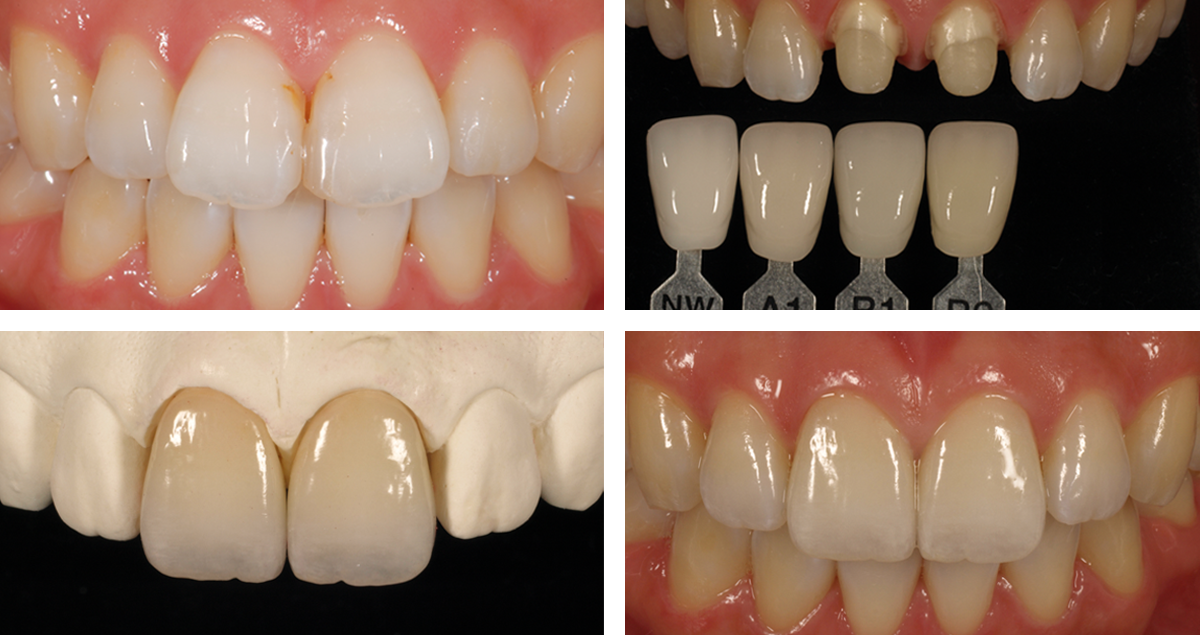
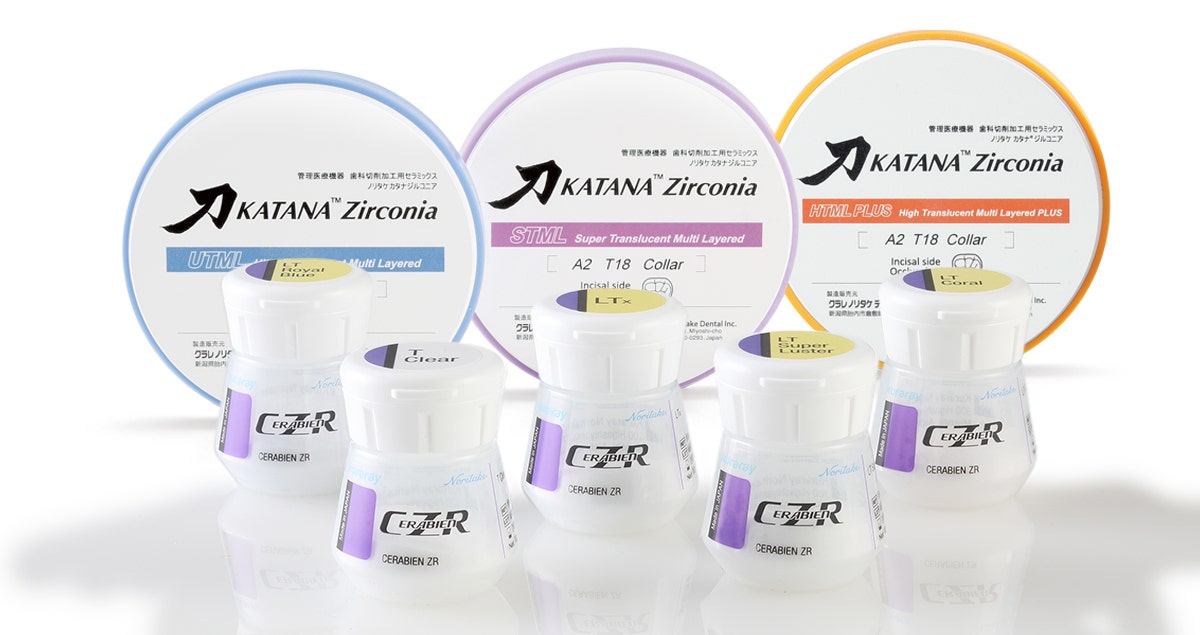
In 2015, Kuraray Noritake Dental Inc. launched the new KATANA Zirconia UTML and STML. With this outstanding multi-layered zirconia you can reach high level of esthetic in less steps than usual working steps of layering porcelain technique. Just mill and sinter. Due to great properties of this new material, you will get a high esthetic and natural like result. On the other hand, there are many works existing in clinical situation that only professional handmade can achieve the highest esthetic level. Multiple porcelain layering and Internal Stain technique have bigger possibility sometime to show beyond natural.


Fig. 1. Pre-operative photo.


Fig. 2. After preparation.


Fig. 3. Checking the fit of Zirconia Frameworks on model.


Fig. 4. After 1st baking of OB as washbake.


Fig. 5. After wash-baking, using with Internal Stain A+ on the margin area to make a natural cervical color from Zirconia.


Fig. 6. Applying Opacious Body (OBA1) considering with mamelon structure. And apply Body A2B to make high chrome area on cervical area.


Fig. 7. After baking Opacious Body (OBA1).


Fig. 8. After applying Body porcelain (A2B), using wit Cut-Back method to make a space for applying Enamel & Luster porcelains.


Fig. 9. Applying Enamel porcelain (E2) and Luster Porcelain (T Blue) for explaining translucent gradation on the edge of mamelon.


Fig. 10. Applying E2 for making White-band and LT1 for making incisal edge. Considering of porcelain shrinkage after baking, apply 13% bigger than final shape.


Fig. 11. After baking.


Fig. 12. Internal Stain application Applying A+ for cervical color and White for make white spots on incisal area.


Fig. 13. Applying E2 on Cervical area and LT1 for covering surface. And using with E2 on the edge of incisal to make Hallow Effect.


Fig. 14. After baking and morphological correction. Then self-glazing.


Fig. 15. End result.


Fig. 16. Post-operative photo.


Courtesy: Kanare Technical Center in Japan


Implant-supported fixed partial denture

Case by Sung Bin Im, MDC, CDT and Sergio R Arias, DDS, MS


MINIMAL CUT-BACK DESIGN


KATANA multi-layered zirconia allows me to achieve great esthetic and functional outcomes on high risk patients.


Step 1. Titanium Abutments (#7, 9) were placed on the solid model.


Step 2. Zirconia Frame (KATANA Zirconia HT10) cut-back designed to minic anatomical dentin structure and incisal frame.


Step 3. Application and firing of Cerabien™ ZR (CZR) to achieve target shade and incisal effect.


Step 4. Completion of Internal Stain firing.


Step 5.
Completion of Luster and Clear Cervical layering.


Step 6. Surface detail check.


Step 7. Post-operative view.


Recordings 03-07-2021 - YML Symposium Video Recordings

Virtual Kick-Off KATANA Zirconia Symposium


Lecture 1 of 3, Prof. Dr. Beuer
Watch how Prof. Dr. Beuer explains his experience with the new material. Two in one: Combining High Strength and High Translucent Zirconia.


Lecture 2 of 3, MDT Rondoni + MDT Rossi
Watch the recording of the KATANA Zirconia YML Online Symposium on July 3rd 2021, the second lecture plus hand-on which details the experience of MDT Rondoni and MDT Rossi with this new material.


Lecture 3 of 3 + Q&A, MDT Nondas Vlachopoulos
Mister Vlachopoulos deepdives in to a full procedure executed with the new material and demonstrates how liquid ceramics compliment the material establishing a very high-end aesthetic result.


Adhesive cementation of a KATANA™ Zirconia HT 3-unit bridge with PANAVIA™ V5

Case by Dr. Shoji Kato of Takanawa Dental Office, Japan


1. After preparing the abutments

An anterior bridge made of crown and bridge resin has become dislodged. The abutments are vital teeth.


2. Prosthesis

A PFZ bridge with a frame fabricated using KATANA™ Zirconia HT12.


3. Application of Try-in Paste

Evaluate the shade of the cement before cementation.


4. Try-in

After checking the cement’s shade, rinse the prosthesis and tooth surface with water to remove Try-in Paste.


5. Pretreatment of the prosthesis (A)

Sandblast the prosthesis (at 0.3 to 0.4 MPa), clean with an ultrasonic cleaner for 2 minutes, then dry.


6. Pretreatment of the prosthesis (B)

Apply CLEARFIL™ CERAMIC PRIMER PLUS and blow dry with air.


7. Pretreatment of the abutments (C)

Apply Tooth Primer, allow it to react for 20 seconds, then blow dry with air.


8. Application of Paste

Use Universal.


9. Placement of the prosthesis

After placement, remove excess cement using a piece of gauze, a small brush, etc.


10. Light-curing

Light-cure the entire surface of the prosthesis, including the margins.


11. Final polymerization

Make sure the prosthesis is left in place, unmoved, for 3 minutes.


New Zirconia KATANA™ Digital Concept

Since 2010, thanks to its increased translucency, KATANA™ HT has become paramount in fully meeting the ever more demanding aesthetics in restorations where a zirconia frame is used in combination with new generation ceramics CZR. Such ceramics feature an enhanced leucite balancing, which makes them stronger and more durable.


Fig. 1.


Fig. 2.


Fig. 3.


Fig. 4.


Since 2013, ML-Multi Layer technology has made it possible to skip the infiltration phase through multi-layered dentine/enamel millable discs. Such Multi-layered discs allow CUT-BACK solutions that definitely improve the function-related result as the palatal part of the restoration can be manufactured by using KATANA™ ML Zirconia only. Thus, without limiting the aesthetic results (which are reached by enamel-ceramic LUSTER porcelain with “MICRO LAYERING technique”, the restoration benefits of the low abrasiveness of the functional-occlusal areas which is reached through simple and effective mechanical polishing without either surface staining or glasuring.


Fig. 5.


Fig. 6.


Fig. 7.


Fig. 8.


Fig. 9.


New generation KATANA™ UTML and STML introduced in 2015 can be used for anterior restoration thanks to the cubic zirconia based products that have been made available to make it possible to conceive a bi-layer to mono-layer transition in most clinical situations.


Cubic zirconia features superior optical behavior. Although mechanically inferior in performance to conventional zirconia, KATANA™ UTML and STML are aging-resistant, while UTML offers the same translucency as lithium disilicate based solution.


“ZERO-CUTBACK technique” is one of the ideal techniques that can be achieved with cubic zirconia solution. They can perfectly replicate digital projects without any need for subsequent layering and can be easily painted and mechanically polished in the palatal area.


Fig. 10.


Fig. 11.


Fig. 12.


Fig. 13.


Fig. 14.


Fig. 15.


Kuraray Noritake Dental has also developed CZR FC Paste Stain with a wide range of coloring pastes specially designed for full anatomical solution of multi-layered zirconia. Their effectiveness is proven to be enhanced when used with “ULTRA MICRO LAYERING technique” on thin glasure or thin transparent ceramic mass.


Another advantage with STML and UTML products is the lower thickness, respectful of the latest micro-invasive dentistry standards and current market requests.


Fig. 16.


Excellent flexural strengths higer than 550/750 MPa allow restoration to feature micro-invasive thicknesses from 0.4 mm on, p.e. on laminates. Unlike PFZ, zirconia lower thicknesses ensure better results.


Fig. 17.


Fig. 18.


Fig. 19.


Fig. 20.

Fig. 21.


Fig. 22.


Above all, new generation zirconia makes the digital work-flow more efficient and performing, from the intra-oral impression to the final product which can be manufactured “model-free”.


Fig. 23.


Fig. 24.


Fig. 25. Fig. 26.


Fig. 27. Fig. 28.


Thus a new procedure standard is introduced, where simplified adhesive cementation through composite cements opens the the way to zirconia-based adhesive restoration techniques. Regarding adhesion, unlike glass-ceramic, zirconia is not etchable, yet it can be fixed through phosphate monomer MDP, i.e. Panavia™ V5


Fig. 29.


Fig. 30.


Fig. 31.


Fig. 32.


Fig. 33.


Fig. 34.


Fig. 35.


Dentist:

DANIELE RONDONI, MDT


  • Graduating in 1979, Daniele Rondoni opened a laboratory in 1982, which is also the home of the AAT Community College he founded.
  • Teacher and counsellor for the “Italian School for Dental Technicians”at the University of Chieti, University of Sienna and University of Rome Tor Vergata.
  • EAED and IAED Active Member and a SICED Associate and O.L.
  • International Instructor for Kuraray Noritake Dental products.
  • Author of “Tecnica della Multistratificazione in ceramica” (Ceramic Multilayering Technique) and a lab manual about the use of composite materials, introducing his own method – the “Inverted Hardness Layering System”.


Single-shade concept: an adequate option in direct posterior restorations

Case by Dr. Salvatore Scolavino


After decades of developing and improving the matrix chemistry and filler technology contained in resinbased composites, the products available for direct restorative procedures finally seemed technically mature. What remained challenging, however, was the management of the extremely wide range of tooth shades and opacities available for each product: The dentin, body and enamel masses had to be selected and combined in the right way to obtain a perfect colour match and optical integration with the surrounding tooth structure. The difficulties associated with shade selection and calibration of layer thicknesses (particularly the top enamel layer) required to obtain the desired optical (desaturation) effects have now also finally been overcome.


The reason is that further improvements of the composites’ optical properties, mainly achieved through a careful selection and combination of fillers, have enabled the production of materials with optimized light diffusion properties. These properties enable the restorations to blend in smoothly with the adjacent tooth structure, thus paving the way for a single-shade concept (SSC). This concept involves the use of a single mass of composite to restore the function and aesthetics compromised by the loss of dental structure.


This translates into a significant saving of chair time and a high predictability of aesthetic outcome. A composite material supporting a single-shade technique needs to have medium opacity and a technology ensuring that the incoming light is absorbed, reflected and scattered in the right way to merge effortlessly with the surrounding natural dentition and create a biomimetic effect. The following clinical case reveals how the Light Diffusion Technology used in the CLEARFIL MAJESTY™ ES-2 Universal composite system (Kuraray Noritake Dental Inc.) leads to a highly predictable aesthetic integration obtained using the SSC.


Case description


The 30-year-old female patient presented for a check-up, during which it appeared that her composite restorations in the second quadrant (the maxillary left first and second molar) needed to be replaced due to marginal leakage (Fig. 1). Once the rubber dam was in place (Fig. 2), the existing composite restorations were removed using a round multi-blade bur, which allowing for a selective removal of composite and carious tissue. The extension of the cavity was performed with a truncated cone diamond bur (fine). Once the cavity preparation was completed (Fig. 3), the enamel and dentin surfaces were cleaned by sandblasting with aluminium oxide (50 μm). Selective etching of the enamel was performed with K-ETCHANT Syringe (Kuraray Noritake Dental; Fig. 4), followed by thorough rinsing and drying of the tooth (Fig. 5). For the adhesive procedure with CLEARFIL™ SE BOND 2 (Kuraray Noritake Dental), the primer was applied first (Fig. 6), rubbed into the tooth surface for 40 seconds and air-dried. The bond was subsequently applied in the same manner (Fig. 7). After several seconds of air flowing to create homogeneous surface the adhesive was light-cured for 40 seconds (Fig. 8). As the last phase of the adhesive procedure, a 1-mm-thick layer of flowable composite (CLEARFIL MAJESTY™ ES-Flow Super Low A3, Kuraray Noritake Dental) was applied to cover the adhesive on the dentin (Figs. 9 and 10).


Fig. 1. Pre-operative clinical image.


Fig. 2. Isolation with rubber dam.


Fig. 3. First and second molar after cavity preparation.


Fig. 4. Selective etching of the enamel.


Fig. 5. Cavities ready for the adhesive procedure.


Fig. 6. Application of the tooth primer.


Fig. 7. Glossy appearance of the cavities after application of the bond.


Fig. 8. Light-curing of the adhesive layer.


Fig. 9. Application of flowable composite.


Fig. 10. Cusp-by-cusp modelling of the universal composite.


In the modelling phase, the posterior shade U of the composite CLEARFIL MAJESTY™ ES-2 Universal was placed using the cusp-by-cusp technique (Figs. 11 and 12). In order to improve the optical integration of the restorations, some brown stain (CHROMA ZONE™ COLOR STAIN Dark Brown, Kuraray Noritake Dental) was added to the fissures (Fig. 13). For finishing, we used a multi-blade ball-shaped bur and an Arkansas Flame abrasive stone (Fig. 14). Polishing of the restorations was accomplished with the TWIST™ DIA system (EVE; Fig. 15). After rubber dam removal, the occlusal check was performed with articulating paper (Fig. 16), minimal adjustments were made and the surfaces repolished. The integration of the restorations after 30 days fully meets the clinical expectations (Figs. 17 to 20).


Fig. 11. Glossy appearance of the cavities after application of the bond.


Fig. 12. Completed occlusal anatomy.


Fig. 13. Stained fissures.


Fig. 14. Matte surfaces after finishing.


Fig. 15. High-gloss surfaces after polishing.


FINAL SITUATION


Fig. 16. Whole quadrant after rubber dam removal and the occlusal check.


Fig. 17. Whole quadrant at the 1-month-recall.


Fig. 18. Occlusal view of the restorations …


Fig. 19. … after one month.


Conclusion


The innovative composite system CLEARFIL MAJESTY™ ES-2 Universal, which consists of two shades for the anterior and a single shade option for the posterior region, offers the properties needed for a successful implementation of the single shade technique. Used in the posterior region, the material is sufficiently opaque to mask optical irregularities of the underlying tooth structure, while it is translucent enough to provide for an imperceptible optical transition from the tooth structure to the restoration. Irrespective of the tooth shade, the restoration merges smoothly with the surrounding natural dentition, creating a harmonic overall picture.


Dentist:

DR. SALVATORE SCOLAVINO


Dr. Salvatore Scolavino, graduated with honors in Dentistry and Dental Prosthesis from the University of Naples. Dr. Salvatore is a specialist in aesthetics and direct and indirect anterior and posterior adhesive restorations. His focus lies with Conservation, Endodontics and Prosthetics in particular. He is an active member of prestigious academies and scientific societies: AIC -Italian Academy of Conservation, IAED -Italian Academy of Esthetic Dentistry and SIDOC (Italian Society of Conservative Dentistry. Since 2004, he has private practice Nola, Italy.


Dr. Scolavino is a founder of werestoreit.it, an inspiring site that offers abundance and variety of aesthetic clinical cases. Author of the book published by Quintessence Publishing „Direct Restorations in the posterior regions“, author of scientific publications in national and international journals, he is speaker at courses and conferences in Italy and abroad.


Tip from an expert: Adhesive luting of zirconia restorations

By Univ.-Prof. Dr. Florian Beuer MME


There is still some confusion among dental practitioners about how to cement zirconia restorations. In general, all types of cements – adhesive or self-adhesive resin cements and conventional cements – are compatible with all types of zirconia. The actual choice should be based on the restoration design (retentive or non-retentive), the translucency of the zirconia and the clinical situation (feasibility of working field isolation).


When to use which type of cement


The use of adhesive resin cements is mandatory whenever the highest possible bond strength is required. This is the case with one-wing Maryland bridges and other types of restorations lacking micromechanical retention, and with two-piece implant abutments.


In some other situations where retention is not an issue, adhesive or self-adhesive resin cements may have a beneficial effect. The major reason is their more esthetic appearance compared to conventional cements, which offers advantages whenever a highly translucent restorative material is used (e.g. KATANA Zirconia UTML). An important precondition for adhesive luting, however, is a dry working field. Consequently, conventional cements are preferable in the context of placing crowns, bridges and other types of restorations with retentive designs whenever opaque zirconia framework materials are used and / or it is difficult to ensure a dry working field.


How to pre-treat the tooth and the restoration


The highest bond strength of adhesive resin cements to zirconia is obtained after sandblasting with alumina (particle size max. 50 µm, pressure approx. 1 bar). Hence, this procedure is highly recommended. Subsequent steps may be different depending on the cement system employed and should be carried out according to the manufacturer’s instructions for use. On the side of the tooth, enamel etching is important independent of the products used.


Which products to use


In each of the cement classes, there are many different products to choose from. My recommendation is to select a proven and easy-to-use luting material. Among those products achieving the same high bond strength, the solution requiring the fewest application steps seems preferable as it reduces the risk of application errors. At Charité – University Medicine Berlin, we count on PANAVIA cements, which are based on many years of expertise in developing products for adhesive luting of zirconia.


Dentist:

PROF. DR. FLORIAN BEUER


Professor and Chair, Department of Prosthodontics, Geriatric Dentistry and Craniomandibular Disorders, Charité – Universitätsmedizin Berlin, Germany.


Clinical case with KATANA™ Zirconia HTML

Case by Daniele Rondoni, MDT


Evolution in the field of aesthetic dentistry never stops: KATANA™ Zirconia proves its aesthetic potential while also being great function-wise. The full zirconia palatal area is combined with an aesthetic buccal part where CZR Luster mass is only used.


Fig. 1. KATANA™ Zirconia HTML with vestibular cut-back opalescence bio-design.


Fig. 2. Palatal ”zirconia-free“ solution.


Fig. 3. Aesthetic vestibular layering with Luster porcelain.


Fig. 4. Manually polished palatal surface with Pearl Surface Z diamond paste.


Fig. 5. Self glazing in furnace for vestibular porcelain.


Fig. 6. Initial case.


Fig. 7. Hybrid solution.


Fig. 8. Palatal Zirconia free.


FINAL SITUATION


Fig. 9. 4 Years follow-up.


Dentist:

DANIELE RONDONI, MDT


Born in Savona in 1961 where he lives and has worked in his own laboratory since 1982 with his collaborators. Graduated from the dental technician school IPSIA “P. Gaslini” in Genoa in 1979. He continued his education by attending relevant workshops for the “Italian dental school“ and broadened his professional experience in Switzerland, Germany and Japan. Since 2011 Kuraray Noritake Dental International Instructor.


Easy way to finalize KATANA™ Zirconia YML restoration part 2

By Kazunobu Yamada, RDT


With the new KATANA™ Zirconia YML it is extraordinarily easy to produce beautiful restorations. Brilliance and vitality may be added simply by applying CERABIEN™ ZR FC Paste Stain to the monolithic restoration after surface preparation.


A possible technique is demonstrated by Kazunobu Yamada, RDT, in this video.