

Cosmetic camouflage for a patient with periodontal disease
Case by Dt Giuliano Moustakis
When producing restorations for the upper anterior region, the first thing that comes to a dental technician’s mind is the selection of a material that matches the colour and translucency of the patient’s natural teeth. The aim behind this action is to provide a perfect optical integration of the restorations to be produced. In order to achieve this optical integration, however, dental technicians need to focus on the surface morphology as well. The following clinical case is used to demonstrate how restorations with the right colour, translucency and texture are able to create a stunning, natural smile, even in complex cases.
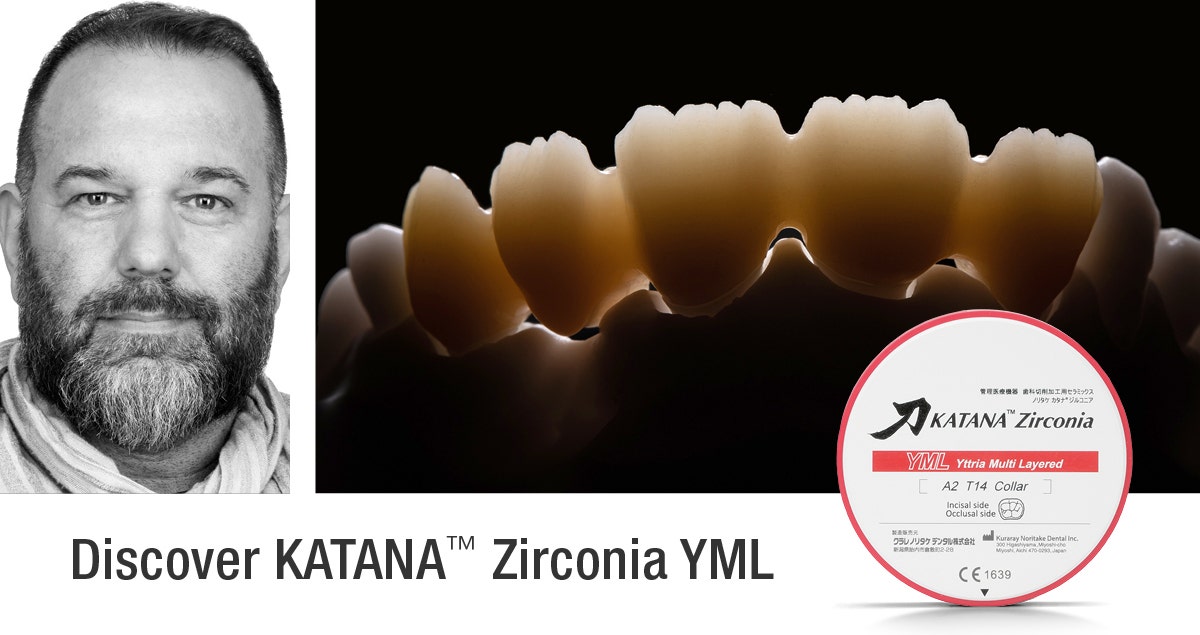
The female patient had a periodontally compromised dentition with a missing maxillary lateral incisor and mandibular prognathism. Spacing was present in both jaws, but the patient decided not to undergo orthodontic treatment due to the challenging periodontal situation and the associated risk of losing additional teeth. Instead, a cosmetic camouflage was planned. As the existing direct restorations on the upper central incisors were in need of replacement, the restoration of choice was an all-ceramic, five-unit bridge. Knowing that this situation would best be solved with a material that offers high flexural strength in the body area (strictly mandatory for five-unit bridges) and high translucency in the enamel part (required to imitate nature in the anterior region), the new KATANA™ Zirconia YML was selected. Thanks to its multi-layer structure with colour, translucency and flexural strength gradation (achieved through yttria content gradation), this material offers exactly the desired properties. We decided to use it with a slight vestibular cutback and microlayering with CERABIEN™ ZR (CZR) porcelain.
Fig. 1 Pre-operative clinical situation with a Class III Malocclusion, a missing lateral incisor, spacing and periodontally compromised teeth in both jaws.
Fig. 2 Lateral view of the pre-operative situation.
Fig. 3 Shade determination in the dental office.
Fig. 4 Maxillary central and lateral incisors and right canine after tooth preparation.
Fig. 5 Printed models of both jaws based on an intraoral scan. This view reveals the discrepancy between the upper and lower jaws that needs to be camouflaged.
Fig. 6 Vestibular and incisal reduction and surface texturing on the pre-sintered restorations made of KATANA™ Zirconia YML. Integration of mamelon structures with a round-end straight carbide bur.
Fig. 7 Integration of horizontal growth grooves with a coneshaped instrument (Panther Stone 040).
Fig. 8 Translucency of the reduced bridge after sintering.
Fig. 9 KATANA™ Zirconia YML structure on the model after sintering.
Fig. 10 Silicone index revealing the space generated in the cutback procedure.
Fig. 11 Evaluation of the camouflage effect.
Fig. 12 Try-in of the zirconia structure.
Fig. 13 Sandblasted bridge ready for microlayering.
Fig. 14 Bridge after the application of internal stains and a single layer of CERABIEN™ ZR Body (A3B) and CERABIEN™ ZR Luster Porcelain (LT1, LT Royal Blue, LTx and LT Coral mixed with Incisal Aureola).
Fig. 15 Chromatic map of the microlayering procedure.
Fig. 16 Palatal view of the restoration.
Fig. 17 Bridge after the first bake and the addition of LT1.
Fig. 18 Finished restoration. In order to optimize the look of tooth and gingiva parts, a final layer of CERABIEN™ ZR FC Paste Stain and Glaze was added.
Fig. 19 Palatal view of the restoration after finishing.
Fig. 20 Try-in of the bridge for aesthetic and functional evaluation.
FINAL SITUATION
Fig. 21 Treatment outcome.
CONCLUSION
This clinical case shows that KATANA™ Zirconia is an innovative material with high aesthetic potential. Despite flexural strength gradation, there are no severe design restrictions that limit the indication range. Instead, it is easy to design and produce even long-span bridges. Furthermore, due to the material’s high aesthetic potential, a monolithic design with zero cutback and paste staining with liquid ceramics is often an option. If users want to add a porcelain layer, a simplified and time-efficient microlayering approach is highly recommended. In any case, a natural surface morphology should be integrated, as it is essential for an aesthetic outcome.